In which we catch up on the various blog posts I’ve been meaning to construct.
Sewing 102
I hosted Sewing 102 a few Saturdays back. We ended up with only two students, rather than my usual four, as Life got in the way at the last minute. The plan this time around, however the student numbers, was to discuss more about seams.
I tried, in my first rounds of planning, to structure the courses as a set of four to six classes that would help folks grasp the general knowledge of the field; at any point, students can drop or add into the cycle, though I always suggest starting at the beginning for a number of reasons. I tend to use folkloric jargon, as I learned my own basics from my mother and grandmother, as they did from theirs. Whether my jargon always lines up with the studied norm is up for debate, but having students there from the get-go helps them maintain understanding on that basic level. Too, I tend to cover things like tension and thread composition, things that sewers tend to either know intrinsically or panic over. Starting at the beginning and following as a single cohort through the cycle streamlines things for all of us.
To that end, I’m planning to schedule a second 102 course for the two students in this cohort in the next few weeks. I’d like to catch them up before I move on to Advanced 201.
In this round of 102, we worked on seams. It was much more hands-on than the last, as we discussed seams in more detail during 101 than I’d initially anticipated (most likely due to my students’ initial knowledge of the craft). I demonstrated a few seam styles, though I didn’t go too in-depth. I like, more than anything, to have students practice on the skills they’ll need for the project at hand, and save the new/advanced stuff for when they’ll need it, as they’ll be less likely to forget it. We chatted momentarily about french and felled seams, but our main focus was on the straight seam.
After practicing, we dove right into quilting. I’d put up to a vote whether we wanted to work on tote bags or potholders, and potholders won out. My goal either way was to discuss a bit of quilting, batting/interfacing, and bias tape. We spent most of the class making quilted potholders. Drawing seam lines, pinning and stitching, and binding the edges took a while, though both students were successful.
My only change, I think, after this cohort finishes up this unit, is to back it down to a singular item. Making two potholders is nice, as it’s a chance to have matching pieces, and the fabric cost difference between one and two each is negligible. But at the same time, I do want these folks to have some of their Saturdays to themselves, and it’s hard to do that if they’re bent over quilting for hours on end. Another option is to include the materials for a second piece to be constructed after class is over (either at home or here, whichever they prefer).
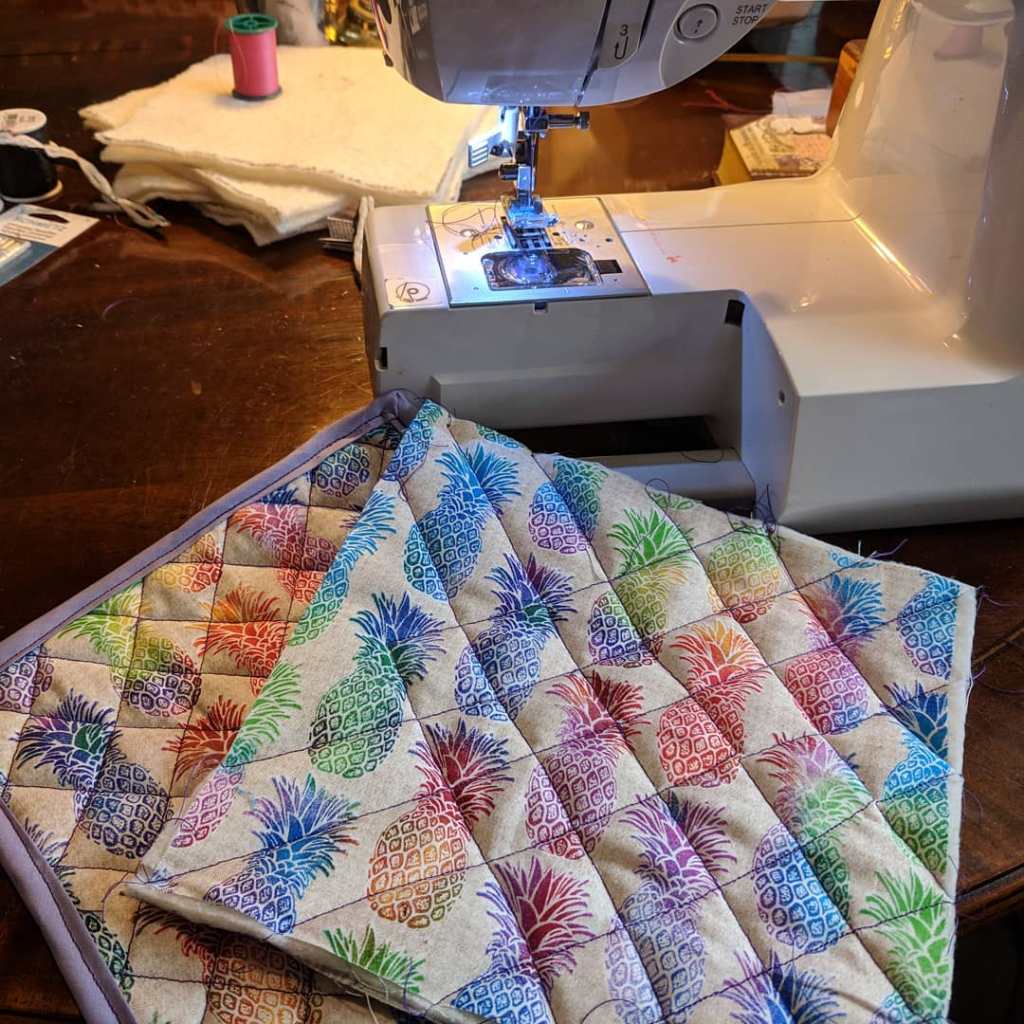
Too, I may have miscalculated in batting choice. Mom and I had discussed using “Insulbrite,” a particular batting made to resist heat, a perfect choice for protecting hands and tables. Unfortunately, the fabric stores on my side of town were fresh out – and frankly, I’m not sure if the closest one actually carries the stuff. We went with a poly-cotton blend and doubled it up instead, but it seems like, upon further research, non-blended cotton works best as a substitute. I’m miffed (my example pieces aren’t very heat-resistant, but at least they’re cute) that the projects aren’t as functional as I’d hoped. My students have been super understanding, though, and I know for next time, so there’s that, at least.
English 1102
I feel like I’m finally starting to settle into 1102. It’s new and different, which is good for my CV, but rough on both me and my students as I muddle through things. As I’ve previously mentioned, Jenn Olive has been instrumental in helping me out, but I’d also like to grant kudos to Jenny Carter and LaRue Cook (websites forthcoming) for their help. Friends and colleagues both, these folks have helped contextualize the assignments mandated by LDS.
We recently finished up the Visual Analysis assignment, in which I asked my students to choose an image related to a game. Knowing from previous classes that my definition of “game” has become more fluid over time, I specified to this class that if they could “convince me it [the subject matter] was a game, they could use it.” I received everything from NBA2K cover art ads to game trailers, comics, and more. The assignment asked for an image that contained an argument, so that they could dissect the argument inherent – basically, I asked them to argue there was an argument here, and use visual evidence to support it.
My grading, as always, is super slow. I did manage to work up a better rubric than I originally had (again, thanks to Jenn), so after a few edits to it, I’ve quickly regraded and caught up to myself. I hope to finish by the end of the week, in time to give my students a better idea of what I’m looking for. Turns out, I can use this new rubric for every assignment, which should help them better see their own patterns and adjust accordingly. They know to look out for it, so now it’s just a matter of finishing in time for them to use the knowledge on their next assignment.
We’ve been discussing Community Literacy the past couple of weeks. So far, we’ve covered a lot. First, we looked at what communities are, how we are a part of them, and how we connect different communities simultaneously. Next, we looked at how communities construct and maintain their identities, namely through “literacy practices.” We connected these concepts to gaming communities (again, vague definition), and [socratically] realized that a good way to conceptualize how these literacy practices work is to study them ethnographically – more specifically, through interviews.
Enter the Community Literacy Essay Project. I’ve asked my students to consider their particular gaming community and select a singular literacy practice that they have participated in (particular practices they’re studying are things like “github” mod creation tactics, League of Legends communication styles, and LGBTQ social games). They then constructed an email template in class and sent it to individuals within each community requesting an interview to discuss these practices. During the interviews themselves, my students will ask questions based on ones they peer-reviewed in class this week and record their subjects’ answers. We’ve taken care to focus on non-protected populations (both to avoid possible ethical violations and the extensive IRB process) and word questions in open-ended ways to avoid possible biases.
Once they have their interviews and ask themselves their questions, they are to write an essay in which they compare these answers. I’m anticipating their first drafts to contain a good bit of “this responder said” and “all the answers to this question were the same.” While this isn’t a bad response, I’ve asked for more nuanced answers, and we will discuss the how-to’s in class Monday during their next peer-review session.
Essentially, their essays should turn out looking more fluid. I plan on illustrating structure along the lines of an introductory paragraph or three in which they consider their community, the literacy practice, and their methodology, sections of “Bolded Question” headers followed by comparing answers (both paraphrased and quoted with explanations), and concluded with a few paragraphs more.
The conclusion section is really the only place in which they’ll formulate an argument. In the question discussion section, their focus is mainly to discuss the differing experiences of these community participants and how they measure up against their own experience with this literacy practice. For instance, in the case of LoL communication as a practice, one question could discuss the merits of a particular form of communication (i.e. text vs voice chat), and how each interviewee uses a different method as compared to the interviewer. The paragraph(s) would go in-depth into each experience, perhaps overlapping one another, and cite each interviewee’s experience, then consider the differences between these experiences and the author’s. It wouldn’t be until the concluding paragraphs of the essay itself that the author would make an argument, perhaps insinuating that the voice-over-web chat is more efficient and effective, but only in the case of known players, and that taking the time to coordinate adding unknown players to [Discord, Teamspeak, etc] voice call would take so much time away from team planning that it invalidates the process’ effectiveness.
Study Abroad
I am probably the most excited I’ve been in a century or more – so excited I’ve slipped entirely into hyperbole.
I’ve booked a study abroad course this spring break in London, UK. I’ll be spending about a week and a half touring, focusing my travels (via class) on theatre, women, and imperialism across the island. We’ll hit Stratford, of course, and the Tower, as well as a few museums and the Globe. The selling point, however (and the major reason I’ve dropped $800 on airfare), was the “personalized archival research day” — the day I’m allowed to hike to Exeter by way of train and spend all day in the archives.
In fact, I’m waiting on a response from their librarians as to whether I can study MS 3501, or if I have to “settle” for the online edition and a tour of the church, grounds, and library. I’d love to spend time with the Exeter Book, but it’s a long shot. Maybe I can convince Dr Christie to write me the equivalent of a permission slip?
I’m planning on a longer post in the next week or two to detail my plans more in-depth, but I’ve been remiss in posting lately, so I wanted to at least get the word on “paper” that I’m going. Class will also require a blog post as part of the assignments, so I’ll most likely post it here and then crosspost to the class blog.
At any rate, “Be excited for me!!!” she screams at her readers in her “capslock” voice. “And then cry for my wallet,” she continues in a horrified whisper.
 The Crafty Medievalist