Photo dump – Traveling home!
https://photos.app.goo.gl/CxET9LKQhSsvqHJL9
This post is cross-posted on the Imperial London Spring Break page as “That time I stepped out of time.” Or, “That time my wife left me for London for two weeks, and all she brought me was a mid-shelf bottle of Scotch.” Or, “That time I understood why Mom said, ‘Ok, so when and where is the next one?'” Or, “That time I looked at my bank after I got back and said, ‘Welp, I’m eating ramen for the next century.'”

I’ve been around the United States more times than I can remember – literally. I travelled across the US with my family every summer between 2001 and 2008, and sometimes fall, spring, and winter, too. I’ve been to most of the spaces in Georgia people are authorized to go, and some they aren’t, since we’ve been camping in it off and on for my entire actual life. I’ve been to Canada once (for a day, maybe) and seen Mexico across the Rio Grande.
But I’ve never had a passport, never had a stamp on a page, never seen anything outside my home continent, and only about a quarter of that, besides.
When Dr Caldwell advertised Imperial London: Women, Theatre, and Empire, I looked at my husband and begged him to let me go. It’s my last semester of coursework, I said, can we find a way to pay for it? And we could maybe afford one plane ticket, and we don’t eat out so much anymore so the food budget was fine, and since he’d been anyway and had to work, I went alone, which terrified me a bit, but I did it, and what a trip it was.
I considered, in this last week of wondering how do I sum up these epic two weeks in one post, writing about the costuming marvels I witnessed. Three shows – Taming of the Shrew, Waitress, Wicked – each brought something new to the table with their costumes and show designs, at least to me. I’ve seen Taming, though not gender-flipped and exquisitely Tudor as it was, but not the other two at all, so it could be that their choices are universal, and that when I [can afford to] see Wicked again, the dresses and styles and choices that visibly support the action and subtleties within the show will probably carry over across the pond; and it’s really hard to believe the “plaid grunge” and “fifties traditional waitress that shifts to modern after the plot turn” look of Waitress that really seems to be the heart of the show wouldn’t be here, too.
It’s hard to decide, without interviewing the costuming department, how much of the designs of each show were dictated in the script, or by directorial choice, or left up to the costumers themselves. With shows that travel/end up in different places like Wicked and Waitress, it’s hard to know. Taming‘s genderflip itself was on the director’s order, but I think, to an extent, he either worked with the costumers or “gave them their heads,” so to speak. From my time as a costume design student, we were encouraged to consider how the clothes we designed would reflect the concepts of the show, and I’m sure, if I’d gone into more, I’d have learned how to do what the RSC’s costumers had probably done – use the modified script as a basis for design and created sketches and defenses to run by the director, then bullied him into accepting them as they reflected exquisitely the characters he’d set up.

At the end of the day, though, all that is conjecture, which is why it’s so hard to dissect costuming from a live show. Your evidence is primary, and getting access to it – during or after a show – can be a tedious process at best. Too, your argument boils down to “the costumer” or “the director” made these decisions to use visuals to reinforce the subjects in the show, which also gets tedious, though the meaty bits don’t.
So instead of writing about costuming, I’ll write about liminal spaces.
An Old English class I’m auditing this semester focuses on landscape, how it impacts the works we read, and how, by analyzing and understanding the world around the author, we can better see and understand the works themselves. I’ve been reading about how Britain, specifically, has what many authors over the centuries have called simply “atmosphere.” They don’t really describe it, and have a hard time defining it, particularly because this “atmosphere” of the country is so hard to define and codify. Having been a closet naturalist and baby scientist for many years, I figured seeing this “atmosphere” for myself wouldn’t be too hard.

So I looked. I looked all over London. I looked in the grey daylight, so often spitting “rain” those first few days, and saw no “atmosphere” I could discern.
I looked in the streets, lined with cobblestone and wending in strange directions. I looked in the architecture, buildings close together, showing clearly their 400-year history butted up against “newer” buildings, those still 200 years young. I looked in the Globe, steeped in historical reconstruction, and in the galleries and museums all over the sprawling town.
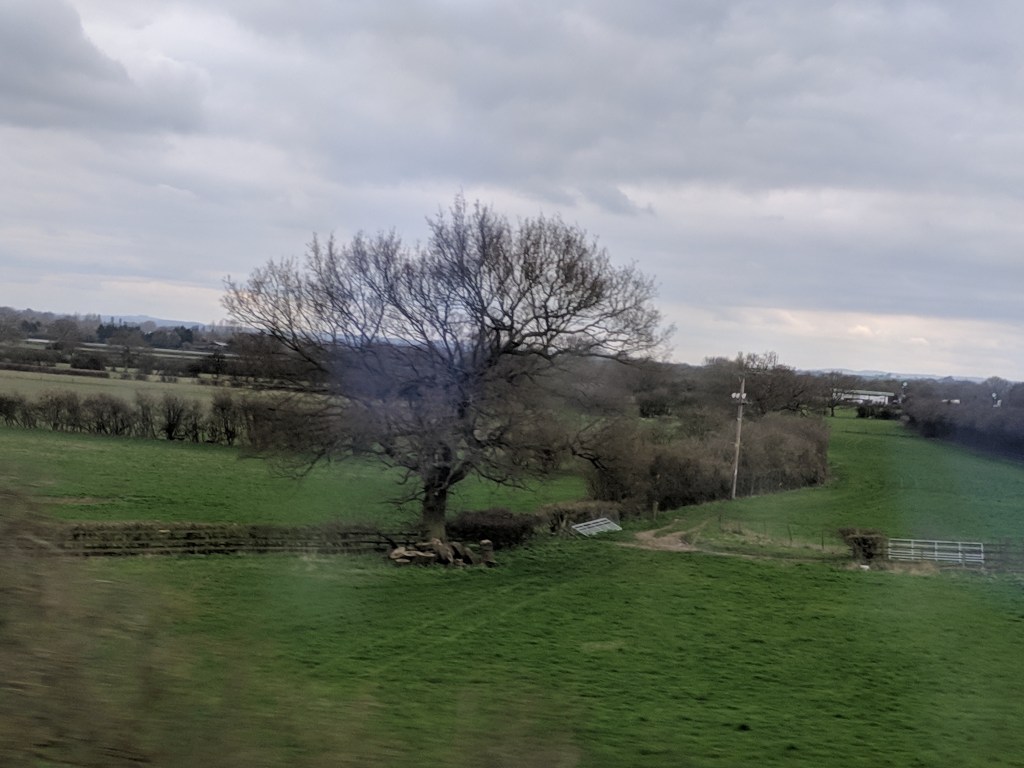
I looked in the landscape of the countryside, where small fields, separated by hedgegrows and ditches and pollarded trees, stood green and verdant in the grey light, in the bright sun, in the subtle hues of dusk. I looked in those trees, some newly growing from cut branches, some reminding me of the old Whomping Willow in Chamber of Secrets with their spindly shoots growing from clubbed branches. I looked in the ponds and rivers in Stratford-upon-Avon, at the swans and ducks gliding gracefully and happily and protected in their homes.
But it wasn’t until I was on the plane home, looking over Ireland and the Atlantic ocean, that I realized what I’d been seeing it the whole time.
Liminal spaces, you see, are typically found in literature – Beowulf’s fens and marshes of Grendel’s home, or Midsummer Night’s Dream‘s gardens of Titania, or any space with no real sense of time, of the world at large, of “reality.”
This whole time, I’d been looking for that feeling of “atmosphere,” that inexplicable sense of place that is distinctly English. I’d been looking to see the fogs over the moor, or for Grendel’s ghost loping across the shadowy field, hoping to find it there or in the landscape somewhere, and when I didn’t feel it, I needed to shift my eyes, shift my focus somehow, slow down. But even when I did, it wasn’t there. Even when I stopped looking for it, I only felt other things, like the press of death and sadness and longing inside the Mummies of Egypt at the British Museum, like the wonder of sunrise in a new place.
No, it wasn’t until I was seated on my flight, “mile high tea” tidied away and lunch long over, having paused in reading my new Little History of Literature, during which I’d been laughing uproariously – it’s written by a cismale white Brit, after all – to visit the toilets. The lights were off when I went in, and had turned on before I came out.
That shift, small as it was, shocked me into understanding that I was no longer in that liminal space I had called England.
Come to find out, it’s hard to realize you’ve been in a liminal space until you’ve left one. At once it occurred to me that I was no longer in England, was no longer bound to the time differential that I had been while on land. I felt awake, myself again, not that I’d been asleep the entire trip, but that I’d been elsewhere. Folklore about going through faerie rings describe a similar phenomenon, and every time I read about it, I’d asked, How could you not know when you’d been elsewhere, elsewhen?
I felt so at home there, so adjusted, that I’d never even questioned whether I actually was somewhere else. It was a new place, yes, but similar enough to home and my other travels that I could – and did – adjust quickly. I loved it, loved being there and analyzing and remembering and documenting everything about it, and want to go back. Not right this moment, I’m too busy relishing being home, but sometime, yes.
How could I not know I’d been in that elsewhere space, that sidestepped land?

I’d stood not five feet from ravens long as my arm, creaky door noises coming from sharp, clacky beaks, the likes of which don’t begin to exist in Georgia. I’d pressed my hand to the glass protecting human remains that were perhaps millennia old and still looked, felt, emanated human. I’d adventured on my own, went to pubs and quiet spaces alike that I’d, back home, have shied from without a partner. I’d put my fear and worry and guilt aside and lived as I hadn’t for a long time, perhaps too much, now that I’ve balanced my checkbook (alright, I’m hamming that up just a bit). I’d stepped into a new PokemonGO community for mere moments, really, expecting nothing but a few folks to raid with and then be done, and came out the other side with friends long after I’d meant to be back in my room.
Maybe I’m new to world traveling, and this is a space – headspace? heartspace? liminal, yes, but beyond that? – that I won’t see again. Maybe I’ll see it when I travel anywhere again. Maybe it is a space that only England exists in. I hesitate to say that this experience was my version of this English atmosphere, as I don’t know for certain what any author’s before me really was, though it does seem to me no-one has used “liminal” and “atmosphere” together before. Maybe it happens to everyone. Maybe I only noticed it because of that opportune toilet visit. Maybe I only noticed it because I wanted to, because I was looking for this “atmosphere.” Maybe I willed the feeling into existence. Or, just maybe, we flew over a faerie ring in Ireland on the way in, and, on the way home, back out the other side.
 The Crafty Medievalist